info@realprogramming.com
(877) 307-3456
A university-preparation Ontario credit, earned online in small live classes with Real Programming 4 Kids. No prerequisite.
BOOK A FREE TRIAL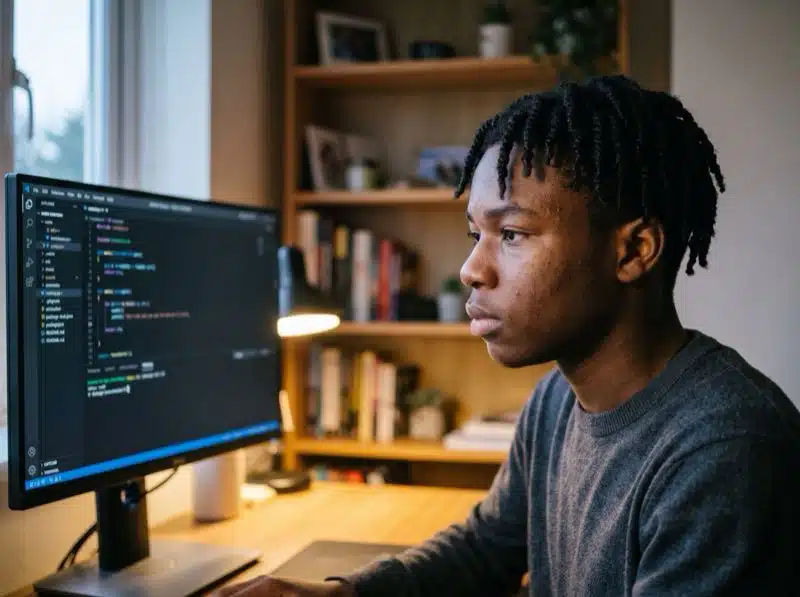
ICS3U is where students start to think like software developers rather than just coders. They design programs on their own and as part of a team, use industry-standard tools, and follow the software development life cycle from problem to tested solution. The language is C++, written and compiled in VS Code, which is the same setup professional developers use.
As a university-preparation course, ICS3U sets a higher bar than Grade 10: students write subprograms, trace algorithms by hand, create formal test plans and explore where computer science is heading, from AI and cryptography to computer vision. There is no prerequisite, so a motivated student can start here, and the course is a direct path toward Grade 12 Computer Science and university programs.
It is taught by Real Programming 4 Kids, which means a live instructor, a small group and real code every session, the way we have taught for more than 25 years.
VIEW CLASS SCHEDULEThe Ontario curriculum for ICS3U has four strands. Here is what your child actually does in each one.
The 18 sessions build in the order a developer would want them: programming fundamentals first, then the discipline of designing and testing software, then the systems that code runs on, and finally the wider field and where it leads. Students are writing and compiling C++ from the early sessions, and the planning and testing habits from the Software Development strand are applied to their own programs as they go.
Assignments are part of the course and count toward the credit. Class time is set aside for them, so most of the work happens with the instructor in the room. The course ends with a final project where each student brings the whole term together.

Every ICS3U class is live and instructor-led over Zoom, two hours a week for 18 weeks. Classes are small, so the instructor sees each student's code as it is written and can step in the moment someone is stuck.
Participation is part of the grade, which is one of the reasons the classes work: students keep their cameras on, explain their logic and review each other's designs. Digital coding reference manuals are handed out in class, and recordings and materials are available between sessions for review.
Real Programming 4 Kids instructors are university students, graduate students or recent graduates with strong programming backgrounds, and every one of them teaches live. For ICS3U, the lead instructor is Candice.

Candice works as a Software Solutions Engineer, so the examples she brings to class come from real industry work. She has taught with Real Programming 4 Kids since May 2025, running live online classes for students aged 6 to 17 and teaching in person at Bayview Glen Camps in the summer of 2025.
Her students have built everything from arcade shooters and platformers in Java to Flappy Bird-style games in Python, and some have gone as far as pathfinding algorithms and feed-forward neural networks.
Before RP4K, Candice taught hands-on STEM classes for middle and high school students with Western University's Engineering Outreach Program, where students built three-foot wooden bridges and tested them by standing on them, and wired their own circuits with batteries, LEDs and breadboards.
She wants her students to develop fundamentals that stay with them well beyond her classroom, and she ends the course with a final project where every student shows what they have learned.
Through our partnership with Above & Beyond Learning, a Ministry-inspected private school in Ontario (MIDENT 665161), students earn actual OSSD credits, not equivalency credits. Above & Beyond Learning is re-inspected every two years against its lesson plans and course outlines, which is what confirms its authority to grant credits.
On completing ICS3U, your child receives an Ontario report card and an Ontario Student Number (OSN), the same documentation an Ontario high school student receives. As a university-preparation credit, ICS3U is the kind of course admissions offices look for from students heading into computer science, engineering and related programs.
REQUEST A CREDIT CONSULTATIONStudents across Canada and the US take our OSSD credit courses alongside their regular high school schedule. Families receive the syllabus, report card and Ontario course documentation needed to request a credit review from their school or district.
Transfer credit and grade placement are determined by the receiving school or district based on its own requirements. Within Canada, British Columbia and Alberta recognize Ontario credits on par with their own.
ICS3U is the prerequisite for Grade 12 Computer Science (ICS4U), the senior university-preparation course, and both sit inside the nine-credit Specialist High Skills Major (SHSM) in STEM. Students who have not yet taken a computer studies credit may prefer to start with Grade 10 Digital Technology and Innovations (ICD2O), though it is not required.
Students who want more coding outside school hours can also join our regular online coding classes for kids, where the same instructors teach game projects in Java, Python and C#.
EXPLORE ALL CREDIT COURSESNo. ICS3U has no prerequisite. It is a university-preparation course, so the pace and expectations are higher than Grade 10, but the instructor builds from the fundamentals, and a motivated student can start here.
Yes. The credit is granted by Above & Beyond Learning, a Ministry-inspected private school in Ontario (MIDENT 665161). Your child receives an Ontario report card and an Ontario Student Number on completion, and the credit counts toward the Ontario Secondary School Diploma.
C++, written and compiled in VS Code. Students install and configure the toolchain themselves during the course, which is part of the Computer Environments and Systems strand.
Assignments are part of the course, and class time is set aside for them, so most of the work is done with the instructor present. Recordings, materials and the digital reference manuals are available between sessions for students who want to review.
Attendance at all 36 hours is expected, since participation is part of the grade. If a session is missed, a one-on-one makeup session can be arranged at an additional cost.
As a Grade 11 University Preparation credit in Introduction to Computer Science (ICS3U), on an Ontario report card issued by Above & Beyond Learning.
Yes. The course is fully online, and families outside Ontario receive the documentation needed to request a credit review from their own school or district, which makes the final decision on transfer.
For more than 25 years, Real Programming 4 Kids has taught programming in real languages, live, in small classes where every student is known by name. ICS3U brings that approach to a university-preparation credit your child can earn from home.

